
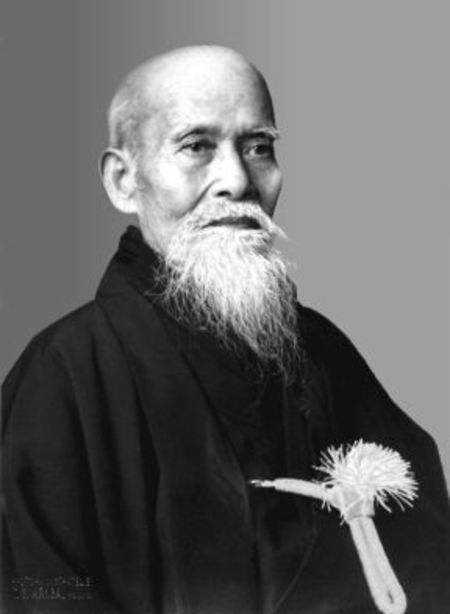
Aikido is a modern Japanese martial art founded by O‑Sensei Morihei Ueshiba in the 1930s. Its technical roots lie primarily in Daitō‑ryū Aiki‑jūjutsu, and it shares historical connections with Judo and classical Japanese Jujutsu. O‑Sensei’s extensive training in traditional martial systems, combined with his spiritual beliefs, shaped aikido into a discipline focused on harmony rather than domination.
Technical Foundations
Aikido consists mainly of empty‑handed throwing and joint‑locking techniques, designed to neutralise aggression without relying on brute strength. Many movements derive from Japanese swordsmanship (kenjutsu), giving aikido its characteristic circular footwork, precise timing, and emphasis on posture and distance.
Training also includes:
- Jo (short staff)
- Bokken (wooden sword)
- Knife disarming techniques
Weapons practice reinforces body alignment, awareness, and the principles underlying empty‑handed technique.
Training Method
Aikido does not include competitions or sparring matches. Instead, students train cooperatively with partners, learning to:
- Blend with an attacker’s movement
- Redirect force rather than oppose it
- Apply technique through ki, focused intention, and disciplined body mechanics
Breathing, balance, and footwork are central to aikido, making it a challenging art that demands both mental and physical refinement.
Philosophy and Personal Development
O‑Sensei envisioned aikido as more than a system of self‑defence. Influenced by his spiritual practice, he shaped aikido into a Way of Peace, a path that teaches practitioners to harmonise with themselves, with others, and ultimately with the world around them.
Many people value aikido not only as a martial discipline but also as a means of:
- Personal growth
- Self‑mastery
- Emotional balance
- Lifelong development
Aikido encourages practitioners to cultivate calmness, compassion, and clarity under pressure — qualities that extend far beyond the dojo.